

Categories
Buying Strategy, Market Trends & Data, Neighborhood GuidesPublished November 8, 2026
A Guide to Barton Hills Architecture: Stenger Homes, Midcentury Ranches and Modern Builds in Austin

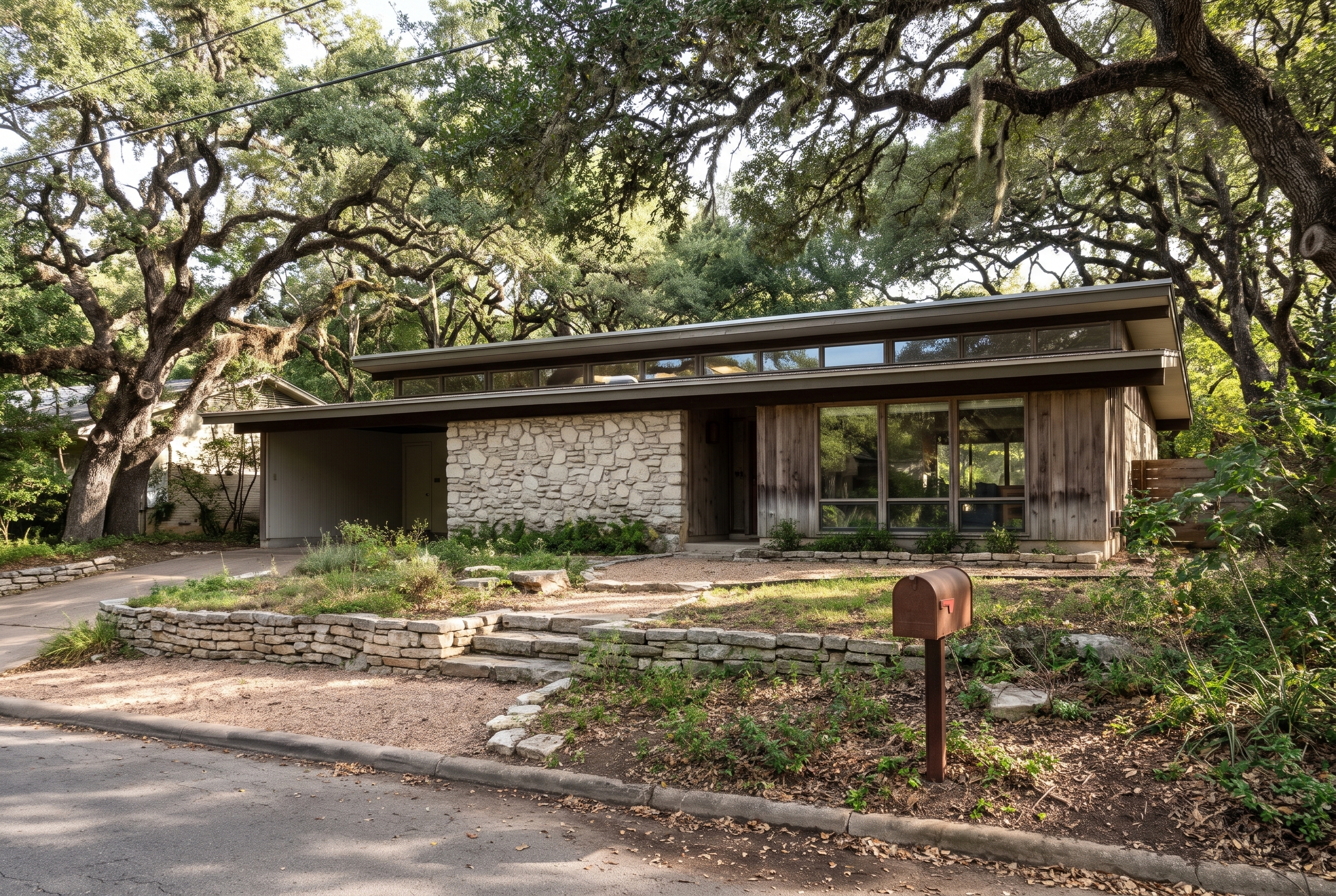
If you're house hunting in Barton Hills and wondering what you're looking at, here's the short version: this 78704 neighborhood runs on midcentury design. A.D. Stenger built a cluster of his signature modern homes along Rundell Place and Airole Way in the early 1950s. Developers then filled the hills with ranch houses after the 1956 Parade of Homes, and the 1970s added split levels on the steeper lots. Today some of Austin's most decorated architects design new homes here, and nearly all of them borrow from that midcentury playbook. At Schmitz & Smith Group, we see buyers pay a real premium for Stenger originals and well done architect renovations, while dated ranches still leave room to negotiate.
Why Barton Hills Architecture Matters Right Now
The broader Austin market has settled into balance. Across the Austin metro this year, the median sale price sits at $367,500 (down 0.7%), homes take a median of 51 days to sell (7 days longer than last year), sellers accept about 1.9% under asking on average, and inventory stands at 5.4 months of supply.
Barton Hills plays a different game. MLS data reviewed in June 2026 put the Barton Hills median list price around $1.485 million with roughly 16 active listings. Across Austin, homes above $1.5 million make up the only price tier posting average gains this year, and walkable, established central neighborhoods have held up best.
Inside Barton Hills, architecture drives a lot of the spread. Look at price per square foot on recent listings:
- An updated 1970 ranch on Barton Hills Drive listed at $562 per square foot and sold in April 2026 after 155 days.
- A new midcentury inspired build by Barley Pfeiffer Architects on Barton Hills Drive listed at $695 per square foot and sold in May 2026.
- A 1950 Stenger original on Rundell Place, renovated by architect MJ Neal, listed at $841 per square foot.
Same neighborhood, same schools, a $280 per square foot gap. The architect's name on the house matters here more than in most of Austin.
A Quick History: How Barton Hills Got Its Look
In 1955, the land east of Barton Creek was mostly empty. Neighborhood historian Dick Kallerman found only one cluster of houses between Rabb Road and the creek on the USGS map from that year: about a dozen homes by A.D. Stenger.
The next year, Austin's 1956 Parade of Homes billed Barton Hills as "the world's largest air conditioned subdivision." S.R. Sheppard, Builders Development Corporation and other developers platted it in six sections, eventually laying out 1,585 lots on 535 acres. Construction ran through the 1960s and 1970s, and in the 1970s developers replatted much of the land west of Barton Skyway into a subdivision called Horseshoe Bend. Builders kept filling in lots into the late 1990s, so you'll see six decades of homes on a single walk.
The Architecture Styles You'll Find in Barton Hills
Stenger Contemporary (1950s)
Kallerman called these houses "Contemporary," a postwar style that owes a lot to Frank Lloyd Wright's Prairie homes. Look for low, sheltering rooflines, clerestory windows that pull light in high, riverstone or limestone walls, stone fireplaces, carports built into the plan, exposed wood ceilings, and decks that reach out into the tree canopy. The Society of Architectural Historians compares them to Joseph Eichler's California homes from the same era, which is why people call Stenger the "Eichler of Austin."
Postwar Ranch and Atomic Ranch (1950s to 1960s)
This makes up most of the neighborhood. Single story ranches sit on generous lots, often 8,000 to 12,000 square feet, under live oak and pecan canopy. The typical home runs about 3 bedrooms, 2 baths and just under 2,000 square feet. Some lean "atomic ranch," with low gables, wide eaves and big front windows. Plenty of owners have opened up the floor plans, added on, or torn down and rebuilt.
Split Levels and Hillside Homes (1970s)
The 1970s brought split levels that step down the hillsides, especially on the cul-de-sacs and in Horseshoe Bend. They tend to have bigger lots and more interesting site lines than the flat ranches, and they also tend to sit lower on price per square foot, which makes them a favorite for buyers planning a remodel.
Architect Designed Modern (2000s to Today)
The new wave of Barton Hills homes mostly speaks the neighborhood's midcentury language: flat or low roofs, big glass facing the trees, concrete and wood, and houses tucked into slopes rather than towering over them. These homes win national design awards and set the top of the price range.
The Architects and Builders Behind Barton Hills
A.D. Stenger (1920 to 2002). Arthur Dallas Stenger grew up the son of an architect in Dallas and Shreveport, served as a Navy Seabee in World War II, and left UT before graduating. He worked as developer, architect and builder all at once, often strapping on a tool belt to finish houses himself and building one home at a time. He chose land just outside the city limits so he could build with fewer restrictions. He designed more than 100 Austin homes, mostly in Barton Hills and Rollingwood. He also once roped a bear on a trip to Spitsbergen, Norway, then had it stuffed and displayed near his desk. Your contractor's office is probably less interesting.
His most famous Barton Hills house, the John Henry Faulk House at 1812 Airole Way, dates to 1951. Stenger cantilevered it over the side of a cliff and used redwood siding, limestone mined on site, a flat roof, and ribbon and clerestory windows. Folklorist and humorist John Henry Faulk lived there, and the City of Austin named it a Historic Landmark in 2009.
S.R. Sheppard and Builders Development Corporation. These developers platted the 1956 subdivision and built much of the original ranch housing stock.
Robert S. Harris. Harris designed the 1966 midcentury home at 1705 Cliffside Drive, known for bold angles and a dramatic central kitchen lit by clerestory windows. Neighbors have long believed Stenger built it. A recent renovation and addition brought in architects Dob and Eel and builder Cary Paul Studios.
MJ Neal. Neal renovated the Stenger home at 2300 Rundell Place in 2009, keeping the original low profile, the clerestories and the stone fireplace.
Alterstudio Architecture. Kevin Alter's firm designed a hilltop Barton Hills Residence with sweeping views of the greenbelt. It picked up an AIA Austin commendation for materials, a 2024 Residential Architect Design Award and an Interior Design Best of Year honor. One favorite detail: a curving reading nook carved into a concrete wall that opens to the pool.
A Parallel Architecture. Their Barton Hills house sets a wood and glass home on top of a half sunken concrete garage, so it keeps the low scale of the midcentury houses around it.
Brett Grinkmeyer Architecture. A 2,900 square foot home from 2017 with big windows that nod to the neighborhood's midcentury roots and a layout built around the tree canopy.
Baldridge Architects. The Barton Hills Brickhouse, built by Arrowhead Construction, channels Palm Desert indoor/outdoor living for a couple who work in the music festival business. Fitting, given who their neighbors are every October.
Barley Pfeiffer Architects. Designed the new midcentury inspired home at 1600 Barton Hills Drive, which sold in May 2026.
Clint Garwood. Designed a builder's personal residence on Brookhaven Drive that hit the market at $2.995 million.
What Buyers and Sellers Should Consider
- Expect three price bands. Based on 2026 listings, updated ranches run roughly $1.1 million to $1.6 million, Stenger originals and architect renovations $1.8 million to $3 million and up, and new architect builds $2.5 million and up.
- Set the right search alert. Several Rundell Place homes show up in the MLS under the subdivision name "Stenger A D Add." Stenger homes rarely come up, so set an alert and move fast when one does.
- Budget for 70 year old bones. Original plumbing, single pane glass in those clerestories, flat or low slope roofs, and hillside drainage all deserve a hard look. I attend every inspection, and I can get trade pros out for estimates during the option period.
- Don't assume protection. The Faulk House holds landmark status, but most Stenger homes don't. Teardowns happen, so the street you love today can change.
- Plan additions around the hills. Slopes, heritage trees and watershed rules can limit how much you can add. Check impervious cover limits with the city before you fall in love with a floor plan.
- No HOA. Barton Hills has an active neighborhood association but no HOA, so you get freedom and no common area maintenance.
- Sellers: document the provenance. If your home has an architect's name attached, gather the plans, permits and renovation history. Buyers will pay for a story they can verify.
Neighborhood Spotlight
Rundell Place and Airole Way
- Price range: Recent Stenger listings have asked $1.85 million to $3 million.
- Vibe: Low slung midcentury homes under heritage live oaks and elms, tucked off Rabb Road near Azie Morton.
- Best for: Design lovers who want an original and will maintain it like one.
- Local detail: You can walk to Barton Springs Pool and Zilker Park, and the Faulk House cantilevers off the cliff on Airole Way.
Barton Hills Drive and the Original Sections
- Price range: Updated ranches have recently listed around $1.2 million to $1.6 million.
- Vibe: Classic 1950s and 1960s ranches on big lots, many remodeled, some replaced.
- Best for: Families who want Barton Hills Elementary, O. Henry Middle and Austin High, plus a yard.
- Local detail: The Gus Fruh trailhead into the Barton Creek Greenbelt sits right on a residential street at 2642 Barton Hills Drive.
Horseshoe Bend
- Price range: Median sold price around $1.775 million.
- Vibe: 1970s hillside homes and split levels mixed with newer custom builds.
- Best for: Buyers who want elevation, views and bigger lots.
- Local detail: Residents here and in Barton Hills fought the proposed Barton Skyway bridge over concerns about traffic and damage to Barton Creek.
Frequently Asked Questions About Barton Hills Architecture in Austin
❓ Who was A.D. Stenger?
A.D. Stenger (1920 to 2002) was an Austin architect, developer and builder who designed more than 100 midcentury modern homes, many of them in Barton Hills and Rollingwood. His homes feature low rooflines, clerestory windows, stone walls and open, informal layouts. People often call him the "Eichler of Austin."
❓ Is now a good time to buy a midcentury home in Barton Hills?
The Austin market overall leans balanced right now, with 5.4 months of supply and homes selling a little under asking. In Barton Hills, that means more room to negotiate on dated ranches. Stenger originals and architect renovations still draw serious buyers, so don't expect big discounts there.
❓ What price range is most competitive right now?
Updated ranches between about $1.1 million and $1.6 million draw the most buyers because they offer Barton Hills schools and greenbelt access without a top tier price. Homes that list high without the design pedigree to back it up tend to sit; one Barton Hills Drive listing spent 362 days on the market and cut $201,000.
❓ Which Barton Hills streets have A.D. Stenger homes?
The biggest concentration sits along Rundell Place and Airole Way, near Rabb Road. Several of those homes appear in the MLS under the subdivision name "Stenger A D Add."
❓ How much should I budget beyond the purchase price?
Plan for property taxes that scale with these prices; one $2.6 million Barton Hills listing carried about $49,000 a year in taxes. Older homes also need a repair reserve for plumbing, roofing, windows and drainage. Get contractor bids during your option period so you negotiate with real numbers.
❓ What mistakes should buyers avoid?
Don't fall for clerestory windows and skip the roof and plumbing inspection. Don't assume you can add a second story or a big addition on a sloped lot without checking city rules first. And if you want a Stenger, don't wait a few days to think about it; they rarely come up.
Thinking About Barton Hills?
If you're thinking about buying or selling a midcentury home in Barton Hills, we'd love to help you think it through strategically. The Schmitz & Smith Group works with buyers and sellers across Central Texas, including Hyde Park, Westlake, Barton Creek, Tarrytown, Dripping Springs, and beyond.
Reach out anytime to start the conversation. 512-466-5224
or another way