

Categories
Market Trends & DataPublished December 17, 2025
2026 Short-Term Rental Outlook: What Austin Real Estate Investors Need to Know Now

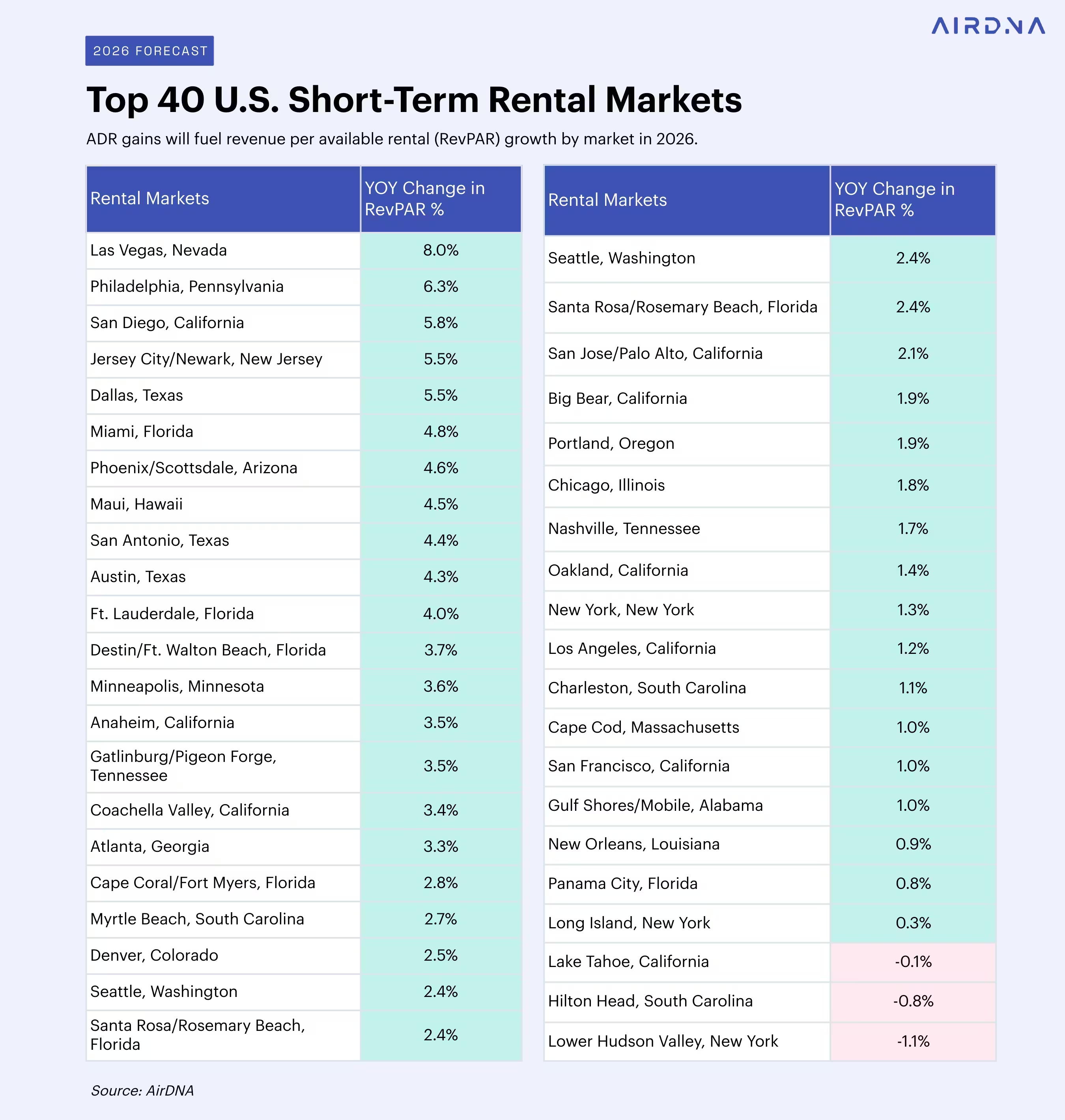
After several years of uncertainty, the short-term rental (STR) market is entering a new, more disciplined phase so for many investors, 2026 may represent the strongest window of opportunity since 2021.
According to the newly released U.S. 2026 Short-Term Rental Outlook, the national STR market is stabilizing after a prolonged reset driven by rising interest rates, shifting regulations, and post-pandemic oversupply. The takeaway is clear: returns are improving, competition is still relatively muted, and entry points are becoming more attractive — especially for well-researched markets like Austin.
Here’s what this report means for Austin-area real estate investors, and how to think strategically about short-term rentals over the next 12–24 months.
The Big Picture: A Healthier STR Market Is Taking Shape
Nationally, the STR market has spent the last few years recalibrating. After record-breaking returns in 2021, supply surged faster than demand, compressing occupancy and margins. That imbalance has largely corrected.
Looking ahead:
- Occupancy is expected to bottom out in 2026, then begin climbing into 2027
- Average Daily Rates (ADR) are growing steadily, not explosively — a sign of stability
- Mortgage rates have settled, with most forecasts keeping them just above 6%
- Home prices are flattening or softening in many STR-friendly markets
This convergence creates a rare moment where improving revenue meets lower competition and more realistic pricing — a combination investors haven’t seen in several years.
Why This Matters for Austin STR Investors
Austin sits at the intersection of several favorable long-term trends:
- Strong population and job growth
- A diversified economy (tech, healthcare, education, creative industries)
- Consistent leisure, festival, and event-driven travel
- Year-round demand that supports flexible rental strategies
At the same time, Austin has also experienced:
- Elevated home prices since 2020
- Regulatory nuance around short-term rentals
- Increased investor caution following interest rate hikes
The 2026 outlook suggests that these pressures are easing, creating a more balanced environment for investors who prioritize fundamentals over speculation.
The STR Premium Is Rebounding — Quietly but Meaningfully
One of the most important indicators in the report is the “STR premium” — the difference between expected monthly STR revenue and the monthly mortgage payment on a newly purchased property.
After falling sharply in 2022–2023, the STR premium has rebounded to nearly $1,000 per month, its highest level in more than two years.
Why this matters:
- Investors are once again seeing positive monthly cash flow potential
- Returns are improving before new supply floods the market
- There is typically a 1–2 year lag between rising returns and increased competition
For Austin investors, this suggests that early-to-mid 2026 may be a sweet spot — before broader investor sentiment catches up.
Softer Home Prices Create Better Entry Points
While Austin home values remain higher than pre-pandemic levels, the report confirms what many buyers are already seeing on the ground:
- More listings
- Longer days on market
- Increased willingness from sellers to negotiate
Nationally, home values began softening in mid-2025, and this trend is especially relevant for STR-friendly properties that were previously priced out of reach.
For investors, this doesn’t mean “cheap” — it means more rational pricing, better underwriting, and the ability to structure deals with long-term viability in mind.
Demand Is Expected to Recover — Just Not All at Once
The report notes that STR demand may remain somewhat muted through early 2026 due to slower income and employment growth. However:
- Household income is expected to recover first
- Travel demand historically lags income recovery
- STR demand is forecasted to accelerate into late 2026 and 2027
For Austin, this reinforces a key principle: short-term rentals work best when viewed as medium- to long-term investments, not quick wins.
Investors who enter during a period of softer demand often benefit most when travel rebounds — especially in markets with strong underlying appeal.
Supply Growth Is Returning — But Gradually
STR supply nationally appears to have bottomed out in 2025 and is expected to grow modestly in 2026. Importantly:
- New supply tends to follow improved returns with a delay
- Regulatory friction and higher entry costs slow rapid expansion
- Markets with thoughtful regulation (like Austin) may see more disciplined growth
This favors experienced or well-advised investors who understand neighborhood-level performance, not just citywide averages.
What Smart Austin Investors Are Doing Differently
Based on these trends, successful STR investors in Austin are:
- Focusing on specific submarkets, not broad city assumptions
- Stress-testing deals against conservative occupancy scenarios
- Evaluating hybrid strategies (STR + mid-term or long-term flexibility)
- Paying close attention to zoning, licensing, and compliance
- Buying for long-term appreciation first, STR upside second
This is no longer a market for speculation — it’s a market for strategy.
Our Take: 2026 Is a Window, Not a Guarantee
The 2026 STR outlook is optimistic — but it’s not a promise of effortless returns.
For Austin investors, the opportunity lies in:
- Entering before competition accelerates
- Buying well-located, regulation-compliant properties
- Aligning investment timelines with projected demand recovery
At the Schmitz & Smith Group, we help investors evaluate whether an STR strategy makes sense for a specific property, not just whether STRs are trending nationally.
If you’re considering an Austin investment — short-term rental or otherwise — we’re happy to walk through the data, the risks, and the realistic upside.
Thinking About Investing in Austin Real Estate?
Whether you’re exploring short-term rentals, long-term holds, or hybrid strategies, our team brings deep local knowledge, data-driven insight, and a long-view approach to every conversation.
Reach out anytime — strategy comes before transactions.
or another way